Journal Template


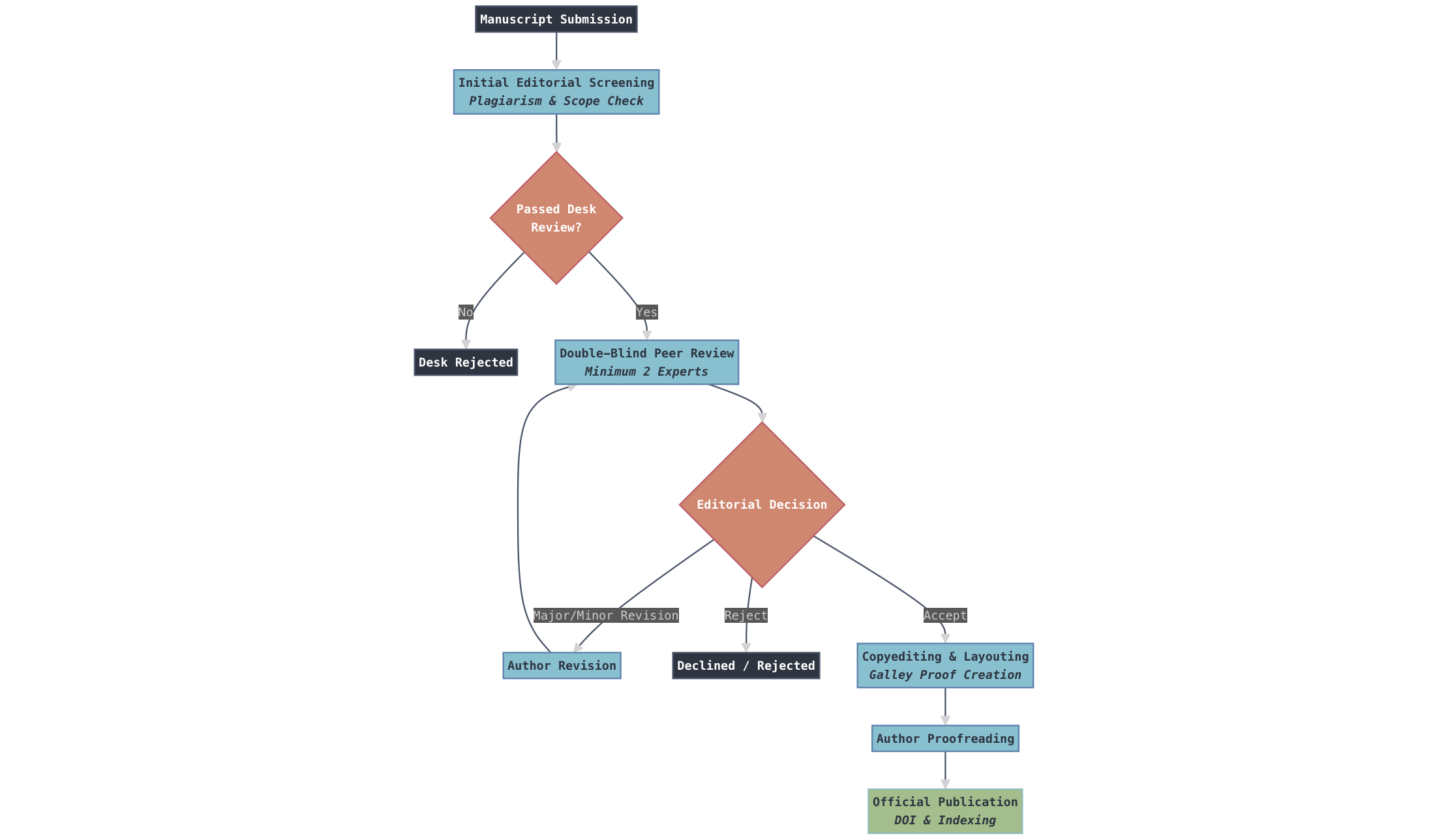
Author Action: The corresponding author submits the manuscript along with supplementary files (cover letter, declaration of originality, etc.) through the OJS submission portal.
System Tracking: The manuscript is assigned a unique tracking ID, and an automatic acknowledgment email is sent to the author.
Scope & Focus Check: The Editor-in-Chief or Section Editor evaluates whether the manuscript aligns with the journal’s scope and focus.
Plagiarism Screening: The manuscript undergoes a plagiarism check using professional software (e.g., Turnitin). Manuscripts exceeding the maximum allowable similarity index are immediately rejected.
Format & Guideline Compliance: The technical editor reviews the manuscript for adherence to the journal's author guidelines and citation style.
Outcome: The manuscript is either Advanced to Peer Review, Returned for Formatting/Correction, or Desk Rejected.
Reviewer Assignment: The editor assigns at least two independent expert reviewers in the relevant field to evaluate the manuscript.
Identity Masking: To ensure objectivity, the identities of both the authors and the reviewers are kept strictly confidential.
Evaluation: Reviewers assess the manuscript based on originality, methodological rigor, clarity, and academic contribution, then submit their formal recommendations and comments via OJS.
Based on the reviewers' evaluations, the Editor makes one of the following decisions:
Accept Submission: The manuscript is accepted as-is without further changes.
Revisions Required: The author must make minor or major revisions based on the feedback within a specified deadline.
Resubmit for Review: The manuscript requires substantial restructuring and will undergo a second round of peer review after resubmission.
Decline Submission: The manuscript is rejected due to critical flaws or insufficient contribution.
Language & Style Editing: Accepted manuscripts undergo professional copyediting to improve readability, grammar, and formatting consistency.
Layout Editing (Galley Creation): The manuscript is typeset into the journal’s official PDF/HTML/XML layout template.
Author Proofreading: The galley proof is sent to the corresponding author for final verification and minor typographical corrections before publication.
Scheduling: The finalized article is assigned to an upcoming issue, volume, and page range.
DOI Assignment: A unique Digital Object Identifier (DOI) is registered and assigned to the article.
Online Publication: The article is officially published as Open Access on the journal’s website.
Metadata Distribution: The article metadata is pushed to international indexing databases (e.g., Google Scholar, Crossref, Garuda, SINTA, DOAJ) to maximize citation and visibility.
Published By :
Yayasan Gemilang Edukasi Madani
Bukit Cimanggu Villa Blok V3/8, Kota Bogor, Provinsi Jawa Barat, Indonesia
jurnal@gemaedu.org, info@gemaedu.org

This work is licensed under a Creative Commons Attribution-ShareAlike 4.0 International License.